

Weekly Market Commentary October 12, 2026
LPL Research examines resilient business lending, narrowing credit spreads, and a housing market constrained by the growing mortgage rate lock-in effect.

Last Edited by: LPL Research
Last Updated: October 12, 2026
Credit Is Still Flowing, and Businesses Are Borrowing
Bank lending rarely commands the attention that payrolls, inflation, or consumer spending do. But it helps determine how much momentum the economy can sustain. Commercial and industrial (C&I) loans, the workhorse of corporate finance, pay for everything from working capital to machinery and software. When banks are willing to lend and companies are eager to borrow, it suggests executives see enough opportunity ahead to put money to work.
Banks Aren't Pulling Back
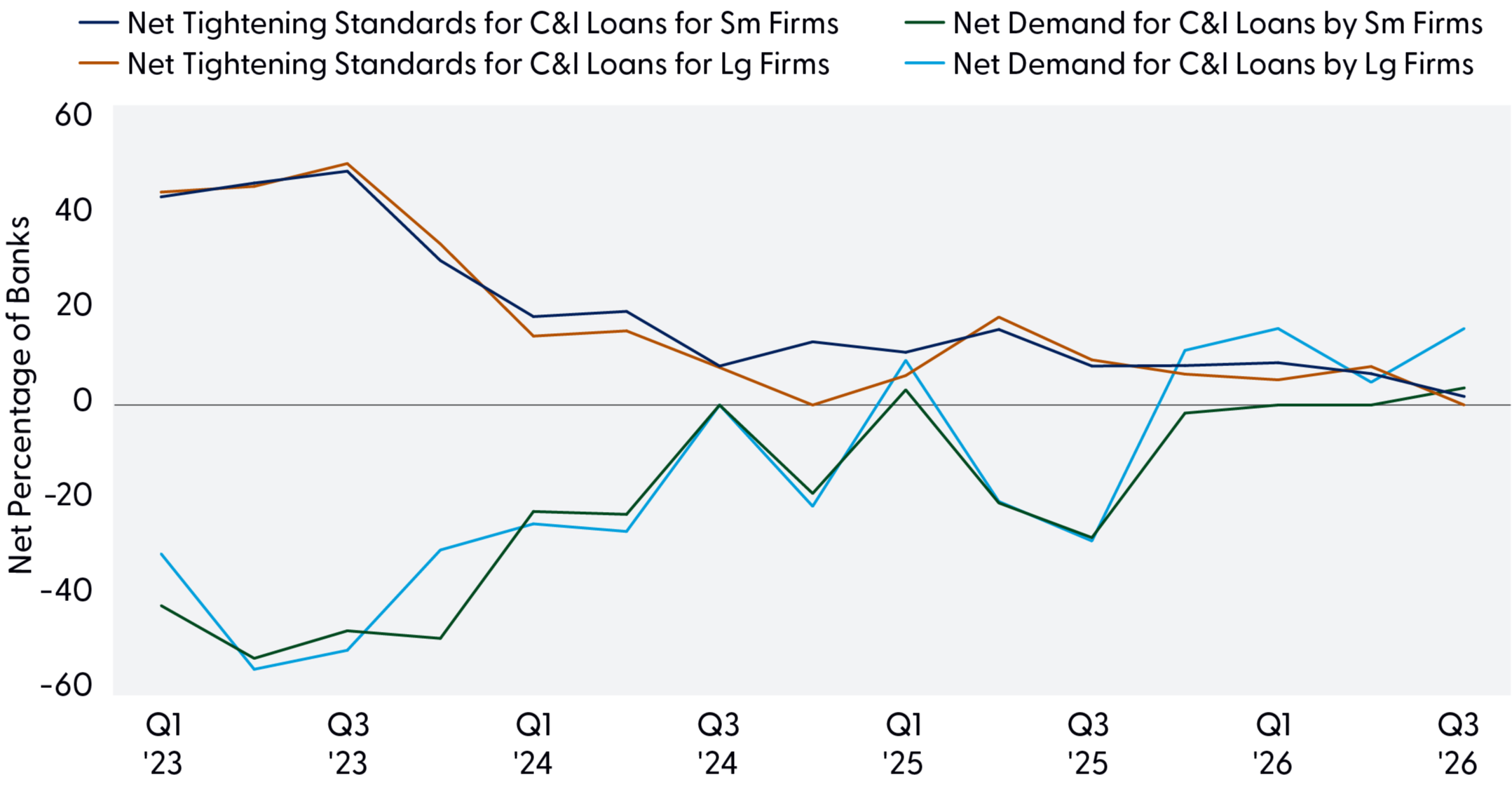
Right now, that is what the data show. In the Federal Reserve's latest Senior Loan Officer Opinion Survey, larger banks left standards for C&I loans basically unchanged, while smaller banks eased. Lenders also reported stronger demand from large and middle-market companies.
That steadiness matters. Standards are looser than they were a year ago, and demand has risen from firms of all sizes. Even after a prolonged stretch of higher interest rates, credit looks more like a tailwind than a constraint for business spending.
The link to the real economy is direct. C& lending tends to move with business fixed investment, a closely watched line item in the GDP report. Stronger borrowing often accompanies spending on equipment, technology, and capacity the kind of outlays that keep paying off long after the check is written.
Firms Demand More, Banks Stop Tightening...
Source: LPL Research, Federal Reserve Board 10/07/26
Disclosure: Past performance is no guarantee of future results. Economic forecasts may not develop as predicted.
Why the Survey Matters
The survey, which often lands ahead of Fed policy meetings, captures both sides of the credit market. It tells policymakers and investors whether banks want to lend and whether borrowers want to borrow. It also offers a near-real-time read on conditions well before they show up in the hard data.
Much of capital spending is tied to technology and infrastructure, this is carrying a large share of the current growth load. If banks stay willing to finance those projects, corporate balance sheets and a solid growth outlook can more easily turn into actual spending.
Consequentially, this also means the direction of lending standards may matter as much as the level of interest rates. A high policy rate doesn't amount to tight credit if banks are competing for borrowers and offering better terms.
Cheaper Credit, Relatively Speaking
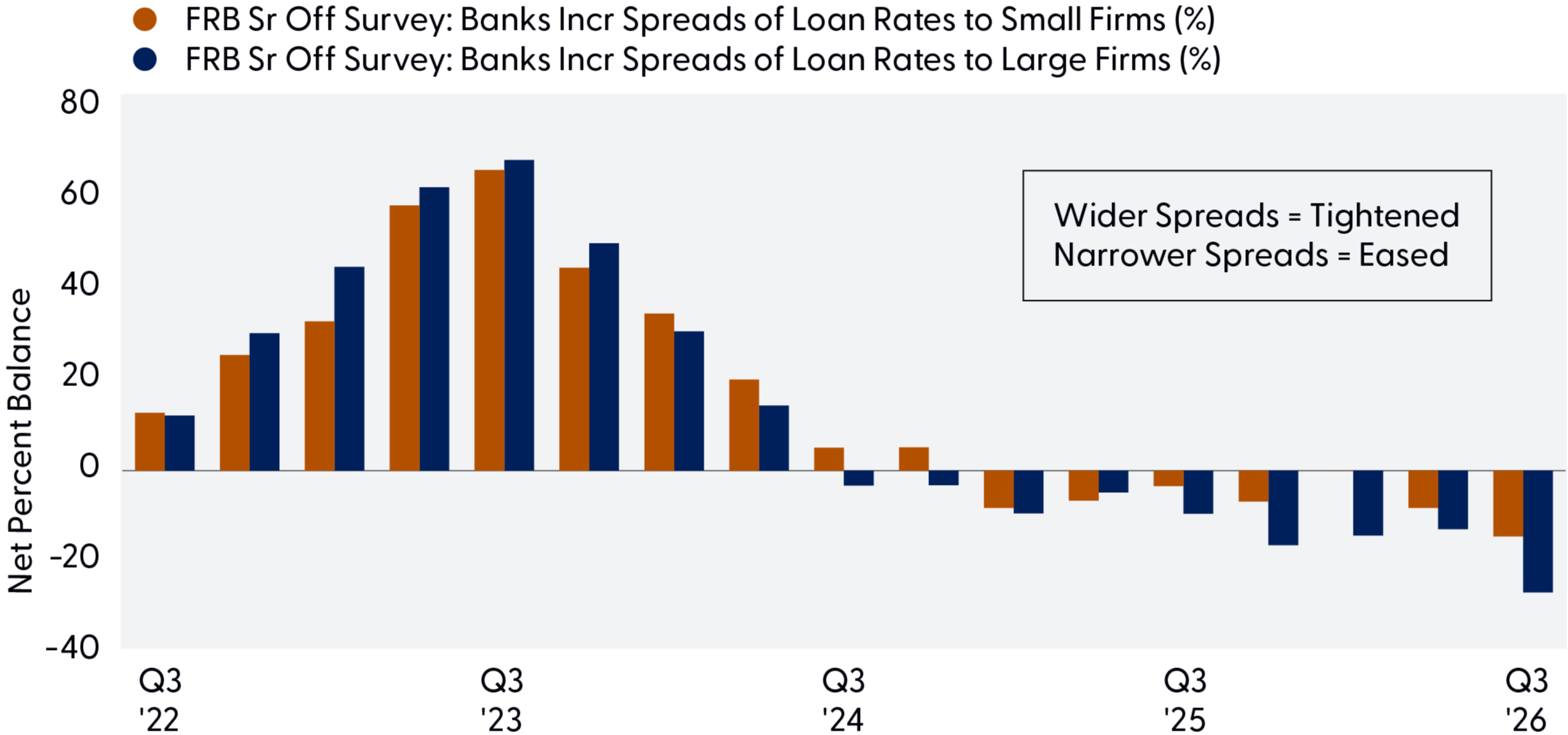
The terms in which credit is being issued are improving as well. On net, more banks are narrowing the spreads they charge over their own cost of funds, a trend that is most pronounced for larger firms. Rates remain high by the standards of the past decade and a half; however, competition among lenders is shaving some of the sting off elevated benchmark rates.
The Fed sets the price of overnight money. Banks decide how much of that restraint reaches businesses. For now, the pass-through isn't particularly restrictive.
...While Spreads are Decreasing
Source: LPL Research, Federal Reserve Board 10/07/26
Disclosure: Past performance is no guarantee of future results. Economic forecasts may not develop as predicted.
Housing is Stuck in Place
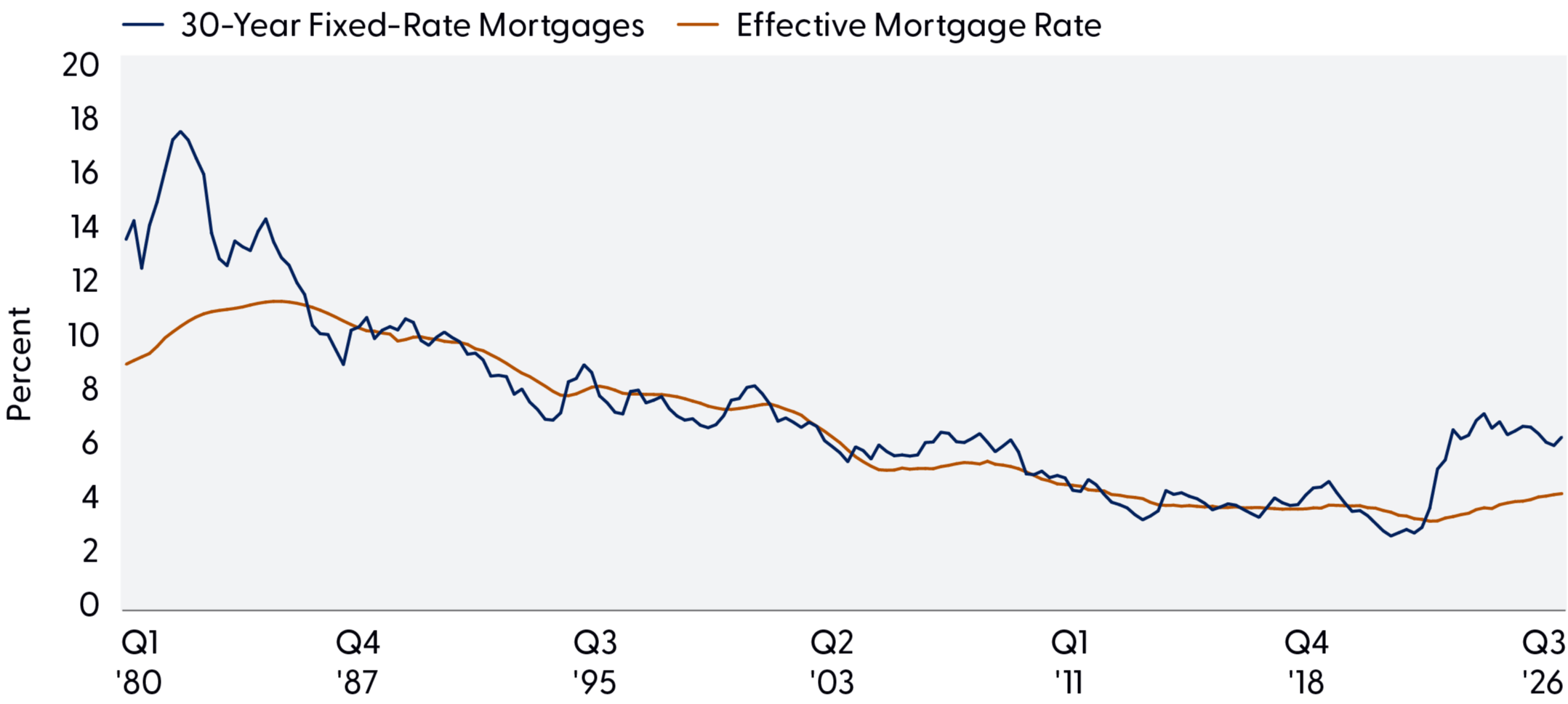
Housing tells a very different story. Mortgage rates rose above 7% in mid-September and, as of October 6, were the highest since January 2025. That is still short of the 8.1% peak in October 2023, but with Treasury markets under pressure, rates could climb further.
The bigger problem is the widening gap between today's mortgage rates and what existing homeowners are paying. Many are sitting on cheap loans and have little reason to give them up. That lock-in effect keeps resale inventory scarce, and new-home sales would need to accelerate sharply to fill the void. The market is constrained not only by high rates, but by the distance between the rate a buyer must take on and the rate a seller must surrender. (Justin Fox of Bloomberg offered the framing.)
The Lock-in Continues as Mortgage Gap Widens
Source: LPL Research, Federal Home Loan Mortgage Corporation 10/07/26
The result is a market that is stuck rather than collapsing. Softer demand has pushed down the median price of a new single-family home, though it remains well above pre-pandemic levels. The regional split is stark. Sales continue to weaken in the West and Northeast, while the South is on a firmer footing. Housing activity usually spills into furniture, appliances, and home improvement, as a result, that strength should support retail spending across the region.
For the broader economy, the math is simple. Residential investment is likely to subtract 0.3 percentage points from growth, and housing isn't poised to power the expansion anytime soon. That then puts more weight on business investment and consumer spending to keep the economy growing.
A Counterweight to the Crosscurrents
The economy faces no shortage of crosscurrents. Housing is hamstrung, labor demand is uneven, inflation pressures persist, and geopolitical shocks have made the path of monetary policy harder to read.
Credit is a counterweight. Companies don't typically ramp up borrowing when they expect activity to deteriorate sharply. Rising loan demand alongside steady or easier lending standards suggests businesses still see opportunities worth financing. That is notable in an economy where residential investment is a drag and capital spending has become a key source of growth.
Conclusion
The economy doesn't need every sector firing at once to keep expanding. Housing can stay stuck behind a wide gap between market mortgage rates and the rates homeowners already hold. Inflation can also remain uncomfortable, just as long as business investment picks up the slack. Attractive lending conditions make that scenario more plausible. Banks are still willing to lend, spreads are narrowing, and companies are asking for more credit despite elevated rates.
That mix should help sustain growth as businesses spend on equipment, technology, and capacity. Inflation and geopolitical risks could still cloud the outlook, but companies appear willing to look past some of the uncertainty when growth opportunities are good enough. For investors, the lending data offers a reassuring signal. Credit is available, businesses want it, and that gives capital spending a driver of growth, even with housing on the sidelines.
Asset Allocation Insights
LPL's Strategic and Tactical Asset Allocation Committee (STAAC) maintains its recommendation for a tactical equity overweight and fixed income underweight. We believe prospects for the macro backdrop to improve and the Al-driven earnings boom will continue to support the broad equity market through 2026. The Committee favors the quality factor to express the tactical equity overweight.
On the fixed income side, we remain neutral relative to benchmark duration. In credit, we prefer to stay up in quality and resist the temptation to reach for spreads in a market where Al-related issuance is already filling the index with long, tight, single-name concentration. Securitized sectors (asset-backed securities and select collateralized mortgage-backed securities) remain attractive, while non-U.S. developed and emerging market debt increase income opportunities and offer diversification benefits.
Jeffrey Roach, PhD, Chief Economist, LPL Financial
Aaron Cleary, Associate Analyst
Phoebe Huynh, Associate Analyst
Important Disclosures
This material is for general information only and is not intended to provide specific advice or recommendations for any individual. There is no assurance that the views or strategies discussed are suitable for all investors or will yield positive outcomes. Investing involves risks including possible loss of principal. Any economic forecasts set forth may not develop as predicted and are subject to change.
References to markets, asset classes, and sectors are generally regarding the corresponding market index. Indexes are unmanaged statistical composites and cannot be invested into directly. Index performance is not indicative of the performance of any investment and do not reflect fees, expenses, or sales charges. All performance referenced is historical and is no guarantee of future results.
Any company names noted herein are for educational purposes only and not an indication of trading intent or a solicitation of their products or services. LPL Financial doesn't provide research on individual equities.
All information is believed to be from reliable sources; however, LPL Financial makes no representation as to its completeness or accuracy.
All investing involves risk, including possible loss of principal.
US Treasuries may be considered "safe haven" investments but do carry some degree of risk including interest rate, credit, and market risk.
Bonds are subject to market and interest rate risk if sold prior to maturity. Bond values will decline as interest rates rise and bonds are subject to availability and change in price.
The Standard & Poor's 500 Index (S&P500) is a capitalization-weighted index of 500 stocks designed to measure performance of the broad domestic economy through changes in the aggregate market value of 500 stocks representing all major industries.
All index data from FactSet or Bloomberg.
This research material has been prepared by LPL Financial LLC.
Not Insured by FDIC/NCUA or Any Other Government Agency | Not Bank/Credit Union Guaranteed | Not Bank/Credit Union Deposits or Obligations | May Lose Value
RES-0007122-0526 Tracking #1189200 | #1189203 (Exp. 10/27)